Tips for the Off-Season

The season is over, you are on a high after hopefully achieving your goals, but now is the time to allow your body a well-earned rest.

However, you probably already have one eye on next season………….

The off season can often be a confusing time for athletes, especially amateur triathletes who may not have the guidance of a coach. You may be asking yourself how much fitness do I maintain? How much rest do I give myself?

As with any sport, it is vital that you understand how to manage the off season, ensuring you find the right balance of recovery vs training to hit the ground running (literally) next season. A well structured winter can give you the foundations to build into next season, allowing for a gradual intensity increase without fear of injury by doing too much too soon.

Here are Life of Tri’s top 5 tips for the off-season:

  1. Take the rest, you’ve earned it

After a long season of training and races, even if you just built up to one event, enjoy the off season and let your body recover. People often feel they have to maintain race fitness over the winter, only to crash in motivation/energy as the new season is just about to start.

  1. Don’t rush your return to full training

Follow a dedicated winter/off season training plan which will allow you to recover then build back up at a sensible rate. The temptation is to ramp up the training to race levels too early which runs the risk of injury or burn out.

  1. Set goals

The off season is your opportunity to plan what you want to achieve in the following season. Whether its setting new PBs or stepping up the distance, the winter is your time to plan, ensuring there is enough time to prepare and recover for events.

  1. Keep on track

Just because it’s the off season doesn’t mean you take your eye off the ball. Continue to record your sessions ensuring you don’t slip into bad habits (regularly missing sessions) or increase training intensity too quickly without realising. Don’t be embarrassed of those zone 2 sessions recorded on Strava/Training Peaks, it takes a sensible head to build the foundations.

  1. Train rain or shine

It’s all too easy to miss a training session because of bad weather or dark nights. Of course, be safe but when possible get outdoors and train. You will need to top up those up those vitamin-D levels which will maintain bone strength and we all know the benefits being outdoors has on your mental health and wellbeing.
Suunto 5 GPS Multi Sport Watch Review

Review: Suunto 5 

At Life of Tri, we recently had an opportunity to test out the Suunto 5, and we were impressed.   In a market where Garmin has a clear foothold, the multi-sport GPS watch market would definitely benefit from increased options, especially more affordable devices.

Suunto as a brand has been causing ripples in the triathlon market for a number of years and their flagship Suunto 9 watch should always be a consideration for those with deep pockets.

However, Suunto has recently released their mid-range offering in the Suunto 5. Can this very reasonably priced watch win over athletes to give up their Garmin?

Is the Suunto 5 any good?

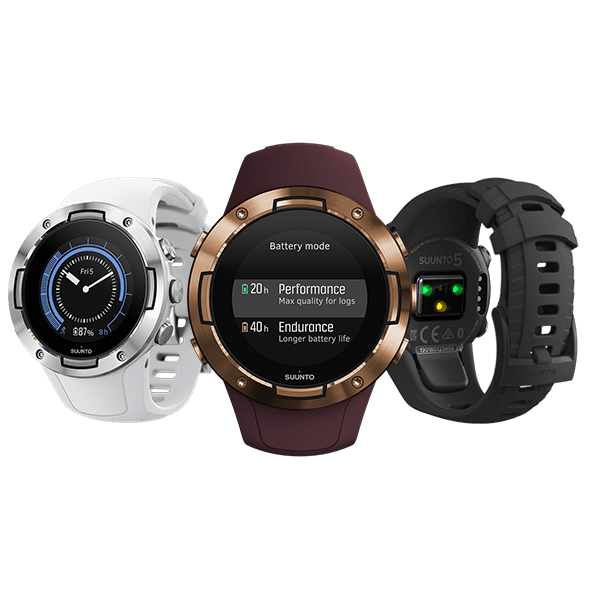
On the face of it, it’s a YES from us at Life of Tri. The Suunto 5 is just over half the price (circa £300) of its bigger brother, the Suunto 9, but they have still managed to pack in a huge amount of functionality. It can support all 3 triathlon disciplines and switching between sports is so straight forward. The Suunto 5 is a normal-sized watch with a 45mm watch face. Thankfully, gone are the days of the brick on your wrist.

The interface and menus on the Suunto 5 are very user-friendly, with logical layouts and button functionality. Although it won’t have all the features you find on a Garmin, it will have everything you need as an amateur triathlete. The battery life will see you training or racing for 20hours in GPS mode, but if you aren’t fussed on using HR, then you can turn off the optical sensor which will extend the battery life up to 30 hours. As a normal watch, the Suunto 5 will last up to 14 days in a charge which is longer than the similarly priced Coros Apex or Garmin 245.

There is no touch screen but a number of manufacturers have moved away from this option recently, so personally, we don’t think it’s a huge loss. Ever tried using a touchscreen when you are shivering from cold or exhaustion? It’s not easy!

We were super impressed with how quickly it picked up the satellite signal, between 10 and 20 seconds, which is more in keeping with the higher-end devices.

Mapping options are limited compared to other Suunto and Garmin mid to high range models, plus there is no mapping intelligence on the watch. However, it will serve 90% of the target audience. Another ‘con’ to consider is that the app isn’t as slick as other manufacturers, but this has definitely seen improvements in the last 12 months or so.

Verdict:

It’s a thumbs up from us, the Suunto 5 provides additional choice at a price that won’t require a re-mortgage

Purchase the Suunto 5 at Here


Bezel material                  : Stainless steel

Case material                   : Glass fibre reinforced polycarbonate

Strap material                  : Silicone

Weight                                 : 66 g / 2.33 oz

Strap width                       : 22 mm

Wrist sizes                         : 130-210 mm

Water resistance            : 50 m (according to ISO 6425)

Display resolution       : 218 x 218

Backlight                             : LED                                                                     

Connectivity                      : Bluetooth Smart


More information on specification can be found on the Suunto website

Review: Suunto 5

In a market where Garmin has a clear foothold, the multi-sport GPS watch market would definitely benefit from increased options, especially more affordable devices.

Suunto as a brand has been causing ripples in the triathlon market for a number of years and their flagship Suunto 9 watch should always be a consideration for those with deep pockets.

However, Suunto has recently released their mid-range offering in the Suunto 5. Can this very reasonably priced watch win over athletes to give up their Garmin?

On the face of it, it’s a YES from us at Life of Tri. The Suunto 5 is just over half the price (circa £300) of its bigger brother, the Suunto 9, but they have still managed to pack in a huge amount of functionality. It can support all 3 triathlon disciplines and switching between sports is so straight forward. The Suunto 5 is a normal-sized watch with a 45mm watch face. Thankfully, gone are the days of the brick on your wrist.

The interface and menus on the Suunto 5 are very user-friendly, with logical layouts and button functionality. Although it won’t have all the features you find on a Garmin, it will have everything you need as an amateur triathlete. The battery life will see you training or racing for 20hours in GPS mode, but if you aren’t fussed on using HR, then you can turn off the optical sensor which will extend the battery life up to 30 hours. As a normal watch, the Suunto 5 will last up to 14 days in a charge which is longer than the similarly priced Coros Apex or Garmin 245.

There is no touch screen but a number of manufacturers have moved away from this option recently, so personally, we don’t think it’s a huge loss. Ever tried using a touchscreen when you are shivering from cold or exhaustion? It’s not easy!

We were super impressed with how quickly it picked up the satellite signal, between 10 and 20 seconds, which is more in keeping with the higher-end devices.

Mapping options are limited compared to other Suunto and Garmin mid to high range models, plus there is no mapping intelligence on the watch. However, it will serve 90% of the target audience. Another ‘con’ to consider is that the app isn’t as slick as other manufacturers, but this has definitely seen improvements in the last 12 months or so.

Verdict: It’s a thumbs up from us, the Suunto 5 provides additional choice at a price that won’t require a re-mortgage

Purchase the Suunto 5 at Amazon


Bezel material                  : Stainless steel

Case material                   : Glass fibre reinforced polycarbonate

Strap material                  : Silicone

Weight                                 : 66 g / 2.33 oz

Strap width                       : 22 mm

Wrist sizes                         : 130-210 mm

Water resistance            : 50 m (according to ISO 6425)

Display resolution       : 218 x 218

Backlight                             : LED                                                                     

Connectivity                      : Bluetooth Smart


More information on specification can be found on the Suunto website

What is Carb Rinsing? and should I do doing it?

You may have heard the term ‘carb rinsing’ used a lot recently, and wonder what is it, and why is it used? Let us at Life of Tri explain…..

Carb rinsing is where you wash your mouth out deliberately with a carbohydrate drink, then spit it out rather than swallowing it. This, in theory, tricks your body into pushing your body further.

Receptors in the mouth sense the carbs which in turn sends signals to the brain, telling it energy is being consumed. Carb rinsing tricks the brain into thinking more fuel is heading towards the muscles, convincing them to work harder or in some circumstances more efficiently.

It is also suggested this technique would have the benefits of consuming carbohydrate drinks without the negative effects of stomach heaviness and cramps.

However, there is debate whether this is a sensible approach and if it benefits those athletes who compete in the long forms of triathlon.

A 2016 study published in Medicine & Science in Sports & Exercise concluded that this technique is more potent during high-intensity sessions lasting around 60mins, with optimum results deriving after eating a high-carb meal around 2-3hrs before your exercise. If you are going longer in your racing or training, it is advisable to fuel sensibly ensuring you have adequate nutrition. Nobody wants to hit the wall or bonk.

However, carb-rinsing may be useful in some circumstances for endurance athletes. Let’s say you have developed stomach cramps during a race, carb rinsing could be a solution when you can’t digest carbs from gels, food or solutions.

For a quality carb drink, check out the SIS range

What is Carb Rinsing????

You may have heard the term ‘carb rinsing’ used a lot recently, and wonder what is it, and why is it used?

Carb rinsing is where you wash your mouth out deliberately with a carbohydrate drink, then spit it out rather than swallowing it. This, in theory, tricks your body into pushing your body further.

Receptors in the mouth sense the carbs which in turn sends signals to the brain, telling it energy is being consumed. Carb rinsing tricks the brain into thinking more fuel is heading towards the muscles, convincing them to work harder or in some circumstances more efficiently.

It is also suggested this technique would have the benefits of consuming carbohydrate drinks without the negative effects of stomach heaviness and cramps.

However, there is debate whether this is a sensible approach and if it benefits those athletes who compete in the long forms of triathlon.

A 2016 study published in Medicine & Science in Sports & Exercise concluded that this technique is more potent during high-intensity sessions lasting around 60mins, with optimum results deriving after eating a high-carb meal around 2-3hrs before your exercise. If you are going longer in your racing or training, it is advisable to fuel sensibly ensuring you have adequate nutrition. Nobody wants to hit the wall or bonk.

However, carb-rinsing may be useful in some circumstances for endurance athletes. Let’s say you have developed stomach cramps during a race, carb rinsing could be a solution when you can’t digest carbs from gels, food or solutions.

For a quality carb drink, check out the SIS range

Socks or No Socks in Triathlon

At Life of Tri, we often say that transition is the 4th discipline in triathlon. If mastered, its an area where you can make quick gains, knocking minutes off your finish time. Getting faster in both transitions (T1 & T2) isn’t about training for hours on the bike, in the pool or on the track, but having a well thought out strategy, and knowing a few tricks of the trade. Knowing your equipment order is vital but one simple decision could save you vital time: ‘socks or no socks?’

Let’s put this into perspective.  This is about endurance triathlons like iron or middle distance because we believe comfort outweighs any marginal time gains. However, let’s consider this over sprint or Olympic distance. Watch any ITU race and the pro will not waste valuable seconds with socks. Their cycling shoes are on in an instance! Wet socks are a real struggle to slide on and sit right.

Going sock free shouldn’t be something you do without practising first though. The risk of blisters increases as activity generates heat, moisture and friction. And let’s be sensible about this, socks were designed to combat blisters.

However, if going sockless is for you, here is Life of Tri’s top tips for ditching the socks but staying blister free:

Lubrication – rubbing wet or moist skin will increase friction. Couple that with salt from sweat or a sea swim, and you have a recipe for disaster. A lubricant like Vaseline can reduce irritation from rubbing. Add this to the key areas where there is increased skin to skin or skin to shoe contact.

Powder – use of talcum powder will help absorb any moisture protecting it from chafing. Like the use of wet lubrication, a powder will reduce rubbing in contact areas. With the added bonus of combating smelly shoes.

Hydration – this seems logical when you think about it, but when you are dehydrated your skin will dry up (increasing the risk of irritation from rubbing), but more importantly your feet swell through the loss of sodium. Keep the fluids topped up and use salt products (if the distance requires it).

Taping – some athletes go to the extreme and will tape their feet with ‘duct tape’ prior to the start of the race. We aren’t sure if this is the best course of action. However, if you decide this is something you want to try, skip the flexible moving part of the feet because duct tape isn’t known to facilitate good running mechanisms.

Can’t do without socks – try this selection of tailor-made triathlon socks

Socks or No Socks

It is often said that transition is the 4th discipline in triathlon, and if perfected is an area where you can make quick gains, knocking minutes off your finish time. Getting faster in both transitions (T1 & T2) isn’t about training for hours on the bike, in the pool or on the track, but having a well thought out strategy, and knowing a few tricks of the trade.

Knowing your equipment order is vital but one simple decision could save you vital time: ‘socks or no socks?’

Let’s put this into perspective, we aren’t talking about endurance triathlons like iron or middle distance because we believe comfort outweighs any marginal time gains. However, let’s consider this over sprint or Olympic distance. Watch any ITU race and the pro will not waste valuable seconds with socks. Their cycling shoes are on in an instance! Wet socks are a real struggle to slide on and sit right.

Going sock free shouldn’t be something you do without practising first though. The risk of blisters increases as activity generates heat, moisture and friction. And let’s be sensible about this, socks were designed to combat blisters.

However, if going sockless is for you, here is Life of Tri’s top tips for ditching the socks but staying blister free:

Lubrication – rubbing wet or moist skin will increase friction. Couple that with salt from sweat or a sea swim, and you have a recipe for disaster. A lubricant like Vaseline can reduce irritation from rubbing. Add this to the key areas where there is increased skin to skin or skin to shoe contact.

Powder – use of talcum powder will help absorb any moisture protecting it from chafing. Like the use of wet lubrication, a powder will reduce rubbing in contact areas. With the added bonus of combating smelly shoes.

Hydration – this seems logical when you think about it, but when you are dehydrated your skin will dry up (increasing the risk of irritation from rubbing), but more importantly your feet swell through the loss of sodium. Keep the fluids topped up and use salt products (if the distance requires it).

Taping – some athletes go to the extreme and will tape their feet with ‘duct tape’ prior to the start of the race. We aren’t sure if this is the best course of action. However, if you decide this is something you want to try, skip the flexible moving part of the feet because duct tape isn’t known to facilitate good running mechanisms.

Can’t do without socks – try this selection of tailor-made triathlon socks


A Brick Session Explained………

A brick session is one where you train two disciplines during the same workout, straight after the other with minimal to no break in between.

This trains your body to instantly start using different muscles, or using the same muscles differently, as you move from swim to bike or bike to run.  When racing you are required to switch from one discipline to the next and so it makes sense to train for this.  The key is to ensure your body is prepared for the next demand while recovering from the previous activity.

Your heart rate will spike as your body tries to shift the blood flow from the muscles of the first exercise to the demands of the muscles of the next. Brick workouts will accustom you to these demands.

For the triathlete, the most obvious reason to use brick sessions is that this replicates the event/race.  You do not compete in each phase of the race in isolation so why would you train in isolation 100% of the time. If you have already competed in a triathlon you may have experienced ‘swim legs’ or ‘bike legs’.  This is where your muscles have been used to performing in a particular way, and then you have to use them differently.

Brick sessions will allow you to ‘switch on’ your muscles to act differently and in a more efficient and effective way.  A brick session does not need to be rocket science, with an over complicated structure.  Just factor in a 10/15-minute run after your bike.

Improving Your Sleep to Become a Better Triathlete

We often think of triathlon as made up of 3 disciplines but it arguably has many more including rest, fuel, transition to name a few….   Ensuring an athlete has recovered sufficiently before the next training session is vital to success in the sport.  Improving your sleep routine is often overlooked and can have huge gains.

Many individuals take their sleep patterns (whether good or bad) as a given, and don’t consider how they can train themselves to improve this element of their lives. The key to sleeping and recovering well is consistency and allowing you the opportunity to relax before trying to fall asleep.

Improving your Sleep Routine Top Tips

These are Life of Tri’s 12 key points to getting a good night’s sleep on a regular basis:

  1. Establish a routine that you consistently stick to each evening. Follow the same routine every night including what you do and roughly when you do it. It will take time to establish any new change to your lifestyle so be patient.
  2. No caffeine for at least 6 hours before bed.
  3. No alcohol or limit your consumption while you are trying to establish a new routine.
  4. No exercise for 2 hours before bed.
  5. Limit food for at least 2 hours before bed.
  6. No screen time for 30-60mins before bed (no tv or phone) – if you have a blue light filter on the phone/tablet switch it on.
  7. Read a book or magazine in the absence of your tv/device.
  8. Have a warm drink – a hot choc or milk but ensure it is low sugar.
  9. Get into the habit of starting your bedtime routine 30/45mins before you want to get into bed – give yourself time to brush your teeth, remove make up, prepare for the following day.
  10. Some yoga or light stretching can relax you. It only needs to be 5 mins of gentle stretching.
  11. Breathing exercises or mindfulness can prepare you for sleep, relaxing your mind – again only needs to be a few minutes.
  12. If you are the sort of person that is still analysing your life at bed time, you need to learn to park these thoughts so your mind is relaxed for sleep. As mentioned, mindfulness is one tool, but making a ‘To Do’ list for the following day is another way of giving yourself permission to stop analysing.

Be consistent with your approach, having the same relaxing routine each evening will allow you to prepare for sleep. Work hard to maintain the new changes for a few weeks which will ensure the routine becomes habit. However, review your new routine to check everything works for you. Don’t be afraid to make tweaks to the routine, or drop a particular element if it doesn’t fit into your lifestyle. You don’t need to do everything suggested above; you need to find what works for you. The new routine should be enjoyable which will help make the change sustainable.

Monitor your sleep with the Fitbit Charge 3

Become a Better Triathlete by Improving Your Sleep

We often think of triathlon as made up of 3 disciplines but it arguably has many more including rest, fuel, transition to name a few….   Ensuring an athlete has recovered sufficiently before the next training session is vital to success in the sport, and the importance of sleeping well is often over looked.

Many individuals take their sleep patterns (whether good or bad) as a given, and don’t consider how they can train themselves to improve this element of their lives. The key to sleeping and recovering well is consistency and allowing you the opportunity to relax before trying to fall asleep.

These are Life of Tri’s 12 key points to getting a good night’s sleep on a regular basis:

  1. Establish a routine that you consistently stick to each evening. Follow the same routine every night including what you do and roughly when you do it. It will take time to establish any new change to your lifestyle so be patient.
  2. No caffeine for at least 6 hours before bed.
  3. No alcohol or limit your consumption while you are trying to establish a new routine.
  4. No exercise for 2 hours before bed.
  5. Limit food for at least 2 hours before bed.
  6. No screen time for 30-60mins before bed (no tv or phone) – if you have a blue light filter on the phone/tablet switch it on.
  7. Read a book or magazine in the absence of your tv/device.
  8. Have a warm drink – a hot choc or milk but ensure it is low sugar.
  9. Get into the habit of starting your bedtime routine 30/45mins before you want to get into bed – give yourself time to brush your teeth, remove make up, prepare for the following day.
  10. Some yoga or light stretching can relax you. It only needs to be 5 mins of gentle stretching.
  11. Breathing exercises or mindfulness can prepare you for sleep, relaxing your mind – again only needs to be a few minutes.
  12. If you are the sort of person that is still analysing your life at bed time, you need to learn to park these thoughts so your mind is relaxed for sleep. As mentioned, mindfulness is one tool, but making a ‘To Do’ list for the following day is another way of giving yourself permission to stop analysing.

Be consistent with your approach, having the same relaxing routine each evening will allow you to prepare for sleep. Work hard to maintain the new changes for a few weeks which will ensure the routine becomes habit. However, review your new routine to check everything works for you. Don’t be afraid to make tweaks to the routine, or drop a particular element if it doesn’t fit into your lifestyle. You don’t need to do everything suggested above; you need to find what works for you. The new routine should be enjoyable which will help make the change sustainable.